Shop : Details
Shop
Details
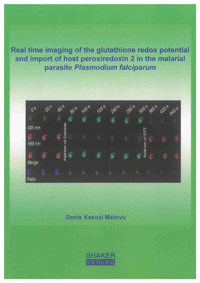
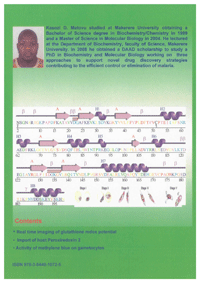
48,80 €ISBN 978-3-8440-1072-5Softcover164 pages92 figures243 g21 x 14,8 cmEnglishThesis
June 2012
Denis Kasozi Matovu
Real time imaging of the glutathione redox potential and import of host peroxiredoxin 2 in the malarial parasite Plasmodium falciparum
Malaria caused by the most lethal Plasmodium species, P. falciparum, remains a major global health problem to almost half the world’s population. To contribute to the identification of novel drug targets and the development of rationally effective combination therapies three approaches to support novel drug discovery strategies were explored in this thesis. First, the role of the glutathione redox potential (EGSH) in the mechanism of drug action and resistance in malaria parasites was systematically studied. Using a EGSH biosensor, comprising human glutaredoxin-1 linked to a redox sensitive green fluorescent protein (hGrx1-roGFP2), the basal cytosolic EGSH as well as the antimalarial drug-induced changes in EGSH were determined in drug-sensitive (3D7) and resistant (Dd2) strains of P. falciparum. By confocal microscopy, the ability of hGrx1-roGFP2 to rapidly react to changes in EGSH due to oxidative and nitrosative stress was demonstrated. Importantly, the cytosolic basal EGSH of 3D7 and Dd2 strains was found to be -314.2 ± 3.1 mV and -313.9 ± 3.4 mV, respectively, which is suggestive of a highly reducing cytosol. Among the tested antimalarial drugs, only methylene blue (MB) rapidly, on scale of minutes, oxidized glutathione (GSH). Notably, following 24 h incubation at 4-fold IC50, artemisinin derivatives exerted, by far, the strongest impact on EGSH. In conclusion, for the first time, the applicability of a highly specific EGSH biosensor for spatiotemporal measurement of the intracellular EGSH, in real time, in P. falciparum was established, illustrating its feasibility for the use in other parasites and pathogens. Secondly, the mechanism of uptake of host human peroxiredoxin 2 (hPrx2) into P. falciparum and its inhibition were investigated in order to identify new drug targets. The molecular mechanism of the uptake of host erythrocytic proteins remains elusive. By bioinformatic analysis of host proteins (~ 30) significantly abundant in parasite protein lysates that exhibited specific abundance profiles across the intraerythrocytic cycle, 4 endocytic vesicle associated motifs were identified including: the sorting and internalization signal (SIS), the tyrosine-based sorting signal (TSS), the clathrin box motif (Clat) and the WXXXY F motif. Notably, hPrx2 had all three endocytic vesicle associated motifs namely SIS (154VDEALRL159), TSS (37YVVL40; 115YGVL118;126YRGL129), and Clat (129 LFIID133). By heterologous over-expressed of hPrx2 mutants in E. coli and incubation with cultures of P. falciparum the role of these motifs was validated. Furthermore, after Western blot analysis of parasite lysates after 24 h incubation at a concentration of 4 x IC50, mefloquine, artemisinin, cytochalasin D, jasplakinolide, paraquat, monensin, CQ and sodium azide inhibited uptake and digestion of host hPrx2. By constrast, ammonium chloride increased uptake of hPrx2 while brefeldin A had no effect on inhibition of hPrx2 uptake. Together the evaluation of endocytic vesicle associated motifs may lead to the development of novel drugs that inhibit uptake of proteins into P. falciparum. Thirdly, the in vitro gametocytocidal activity of MB was evaluated. Notably, the IC50 (95% confidence interval) of MB against young (stage II-III) and mature (stage IV-V) gametocytes was found to be 33.8 (32.1-35.7) nM and 59.5 (37.3-94.8) nM, respectively, indicating that MB has significant activity against all stages of gametocyte development. To reduce the transmission of P. falciparum, incorporation of MB into currently used ACTs is advocated.
Keywords: Plasmodium falciparum; malaria; malaria vaccine; glutathione redox system; hPrx2; hGrx1-roGFP2; glutathione redox potential; antimalarial drugs; redox sensitive green fluorescent protein; human peroxiredoxin 2; methylene blue; gametocytes
Available online documents for this title
You need Adobe Reader, to view these files. Here you will find a little help and information for downloading the PDF files.
Please note that the online documents cannot be printed or edited.
Please also see further information at: Help and Information.
| Document |  | Document | ||
| Type |  | |||
| Costs |  | 36,60 € | ||
| Action |  | Purchase in obligation and download the file | ||
| Document |  | Table of contents | ||
| Type | | |||
| Costs |  | free | ||
| Action |  | Download the file | ||
User settings for registered online customers (online documents)
You can change your address details here and access documents you have already ordered.
User
Not logged in
Export of bibliographic data
Shaker Verlag GmbH
Am Langen Graben 15a
52353 Düren
Germany
Mon. - Thurs. 8:00 a.m. to 4:00 p.m.
Fri. 8:00 a.m. to 3:00 p.m.
Contact us. We will be happy to help you.